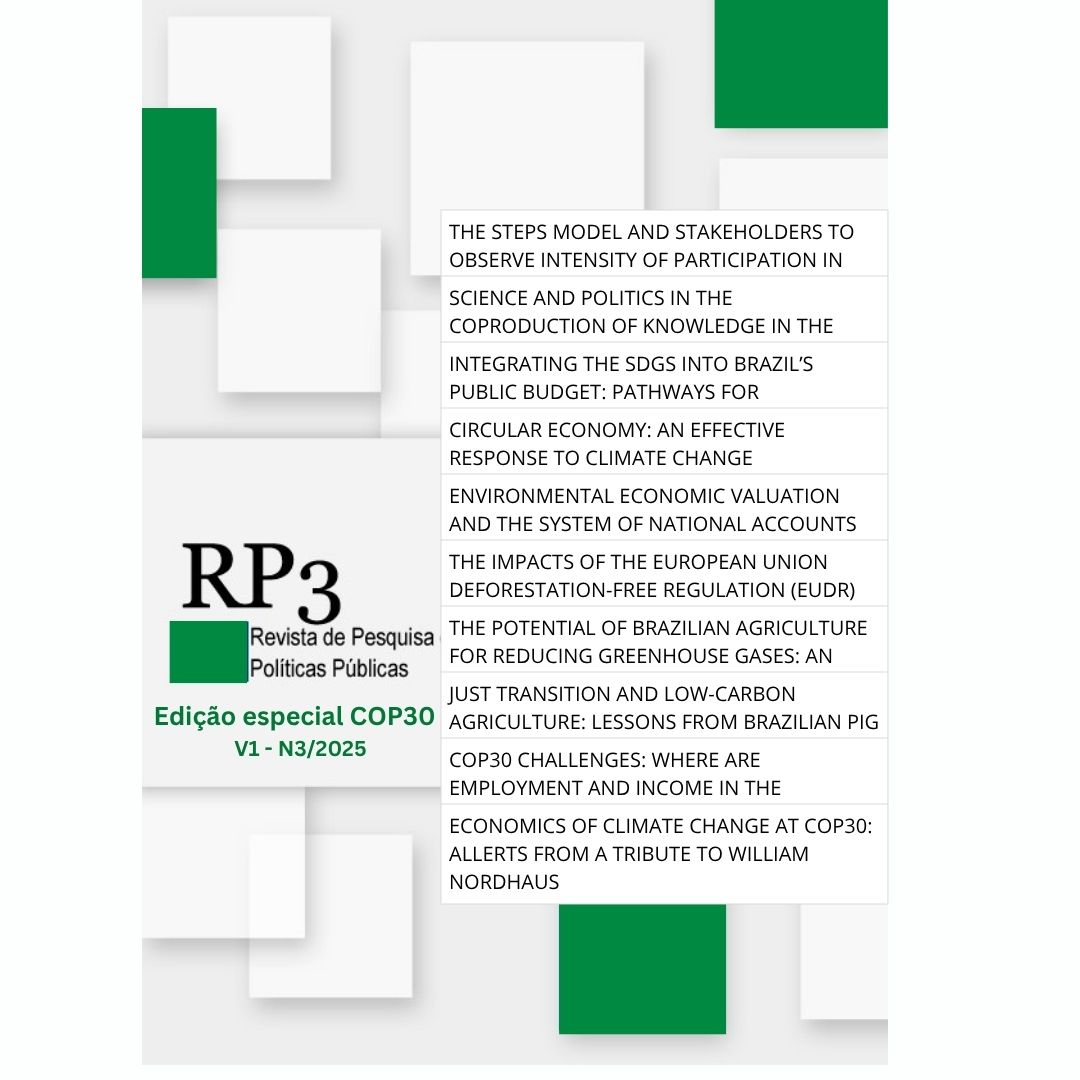
THE POTENTIAL OF BRAZILIAN AGRICULTURE FOR REDUCING GREENHOUSE GASES: AN ANALYSIS OF COFFEE GROWING AND LESSONS FOR COP30
DOI:
https://doi.org/10.18829/2317-921X.2025.e60204Palavras-chave:
GHG Mitigation; Carbon Market; Low Carbon Agriculture; Transaction Costs; Coffee Growing.Resumo
Abstract
This article analyzes the potential of Brazilian coffee production to contribute to national greenhouse gas (GHG) mitigation targets under the recently established Brazilian Emissions Trading System (SBCE). The methodology uses a scenario analysis, based on census data, to assess how transaction costs determine a minimum viable area for market participation, impacting the sector's aggregate potential. The results reveal a critical duality: although there is a vast theoretical mitigation potential, estimated at 13 million tons of CO₂eq, its realization is severely limited by economic barriers that could prevent up to 67% of this total from being realized. The high costs of certifying and monitoring carbon credits exclude most coffee growers, especially family farmers, which constitute the structural foundation of the sector. We conclude that the effectiveness of the carbon market as a climate policy in Brazil depends on institutional innovations—such as collective certification through cooperatives and the development of low-cost monitoring technologies—to reduce transaction costs. Additionally, it is recommended that voluntary instruments, such as carbon-neutral coffee labeling, be promoted to encourage the adoption of good agricultural practices in an inclusive manner and achieve Brazil's GHG reduction targets. Such measures are crucial to ensuring broad and equitable participation of rural producers, aligning the market instrument with the reality of national agriculture.
Downloads
Referências
AKERLOF, George A. The Market for " Lemons ": Quality Uncertainty and the Market Mechanism. The Quarterly Journal of Economics, vol. 84, no. 3, p. 488-500, 1970.
ARAÚJO, MPN et al. Socio-environmental impacts of fairtrade certification on cooperatives of family coffee and mango producers in Brazil. Confins, 2016. Available at: https://journals.openedition.org/confins/11401. Accessed on: October 8, 2025.
BARANZINI, A. et al. Carbon pricing in climate policy : seven reasons, complementary instruments, and political economy considerations. Wiley Interdisciplinary Reviews: Climate Change , vol. 8, no. 4, p. 1–17, 2017.
BRAZIL. Decree No. 10,606 of January 22, 2021. Institutes the Integrated Information System of the Sectoral Plan for Consolidation of a Low-Carbon Economy in Agriculture and the Technical Committee for Monitoring the Sectoral Plan for Consolidation of a Low-Carbon Economy in Agriculture. Official Gazette of the Union, Brasília, DF, January 25, 2021.
BRAZIL. Law No. 15,042 of December 11, 2024. Establishes the Brazilian Greenhouse Gas Emissions Trading System (SBCE) and contains other provisions. Available at: https://www.planalto.gov.br/ccivil_03/_ato2023-2026/2024/lei/L15042.htm. Accessed on: September 13, 2025.
BRAZIL. Ministry of Agriculture and Livestock. Gross Value of Agricultural Production (VBP) June /2025. Brasília, DF: MAPA, 2025.
CACHO, OJ; LIPPER, L.; MOSS, J. Transaction costs of carbon offset projects: A comparative study. Ecological Economics, vol. 88, p. 232-243, 2013.
CASTRO, JC The influence of environmental management systems based on ISO 14001 on the market value of Brazilian companies with shares traded on Bovespa. Dissertation (Master's in Economics) — University of Brasília, 2006.
CASWELL, Julie A.; MOJDUSZKA, Eliza M. Using Informational Labeling to Influence the Market for Quality in Food Products. American Journal of Agricultural Economics, vol. 78, no. 5, p. 1248-1253, 1996.
CECAFÉ; IMAFLORA. Estimativa das emissões e remoções de gases de efeito estufa do café brasileiro - A adicionalidade de carbono devido às boas práticas em fazendas de Minas Gerais, Brasil. Projeto Cecafé (Relatório). Abril 2022.
COASE, RH The Nature of the Firm. Economica, vol. 4, no. 16, p. 386-405, 1937.
CONAB - NATIONAL SUPPLY COMPANY. Monitoring the Brazilian coffee harvest, Brasília, DF, v.12, n. 2, second survey, May 2025.
DUARTE, PAA; FERREIRA, JB Benefits of coffee certification for producers and consumers. 2019. Available at: https://www.researchgate.net/publication/343323445_BENEFICIOS_DA_CERTIFICACAO_DO_CAFE_PARA_OS_PRODUTORES_E_CONSUMIDORES. Accessed on: October 9, 2025.
FOOD AND AGRICULTURE ORGANIZATION OF THE UNITED NATIONS (FAO). The State of Food and Agriculture 2023: Revealing the true cost of food to transform agrifood systems. Rome: FAO, 2023. Available at: http://openknowledge.fao.org/items/1516eb79-8b43-400e-b3cb-130fd70853b0. Accessed on: Oct. 21 2025.
FREITAS, SM et al. Contributions of the agricultural sector to greenhouse gas emissions in Brazil, 2010-2014. Economic Information , São Paulo, v. 46, n. 6, Nov./Dec. 2016. Available at: http:// w ww.iea.sp.gov.br/ftpiea/publicacoes/IE/2016/tec3-1216.pdf . Accessed on: September 17, 2025.
GIOVANNUCCI, Daniele; PONTE, Stefano. Standards as a new form of social contracts? Sustainability initiatives in the coffee industry. Food Policy, vol. 30, no. 3, p. 284-301, 2005.
IBGE. Brazilian Institute of Geography and Statistics. 2017 Agricultural Census: final results. Rio de Janeiro, 2019.
LATYNSKIY, E.; BERGER, T. Assessing the Income Effects of Group Certification for Smallholder Coffee Farmers: Agent- based Simulation in Uganda. Journal of Agricultural Economics, vol. 68, no. 3, p. 727-748, 2017.
MINAS GERAIS. State Secretariat of Agriculture, Livestock and Supply. Certifica Minas Café . Belo Horizonte, 2020. Available at: http://www.agricultura.mg.gov.br/certificaminas/website/documentos/cartilha_cafe.pdf . Accessed on: October 8, 2025.
MOREIRA, CF; FERNANDES, EAN; VIAN, CEF Coffee certification in Brazil: current situation and perspectives. Rural & Agroindustrial Organizations, v. 13, n. 1, p. 1-13, 2011. Available at: https://www.revista.dae.ufla.br/index.php/ora/article/download/429/328/584 . Accessed on: October 8, 2025.
OECD. Voluntary Approaches in Environmental Policy. Paris: Organization for Economic Co-operation and Development, 2003.
PEREIRA, SP Certified coffees from Brazil conquer domestic and foreign markets. Embrapa, November 26, 2014. Interview. Available at: https://www.embrapa.br/busca-de-noticias/-/noticia/2293393/cafes-certificados-do-brasil-conquistam-mercado-interno-e-externo . Accessed on: October 8, 2025.
PERMAN, R. et al. Natural Resources and Environmental Economics. 3rd ed. Harlow: Pearson Education Limited, 2003.
PEROSA, B.; SPARSIS, M. Producer organization and geographic certifications: the cases of coffee from Cerrado and Mantiqueira de Minas. Journal of Economics and Essays, v. 30, n. 2, p. 131-154, Jul./Dec. 2016. Available at: https://seer.ufu.br/index.php/revistaeconomiaensaios/article/view/36605/21890 . Accessed on: Oct. 8, 2025.
PRAKASH, A. Greening the Firm : The Politics of Corporate Environmentalism . Cambridge: Cambridge University Press, 2000.
SANTOS, JF; NOGUEIRA, JM Brazilian Coffee in the Carbon Market: A Prospective Analysis of Financial Viability and Effectiveness. Economics Essays Journal, Uberlândia, v. 40, n. 1, 2025. DOI: 10.14393/REE-v40n1a2025-73702.
SCHMALENSEE, R.; STAVINS, R. Lessons Learned from Three Decades of Experience with Cap and Trade. Review of Environmental Economics and Politics, vol. 11, no. 1, p. 59-79, 2017.
SEGERSON, K. Voluntary Approaches to Environmental Protection and Resource Management. Annual Review of Resource Economics, vol. 5, p. 161–180, 2013.
SEGERSON, K.; LI, N. Voluntary Approaches to Environmental Protection. In: FOLMER, H.; TIENTENBERG, T. (Eds.). The International Yearbook of Environmental and Resource Economics: 1999/2000. Edward Elgar, 1999.
SILVA, Fernanda Aparecida; NONNENBERG, Marcelo José Braga. Voluntary Sustainability Standards (NVS) and implications for exports of agribusiness products – Coffee. Brasília: Ipea , 2023. (Discussion Paper, n. 2911).
STERNER, T.; CORIA, J. Policy Instruments for Environmental and Natural Resource Management. 2nd ed. New York: RFF Press, 2012.
STIGLITZ, Joseph E. The Causes and Consequences of the Dependence of Quality on Price. Journal of Economic Literature, vol. 25, no. 1, p. 1-48, 1987.
WORLD BANK. State and Trends of Carbon Pricing 2025. Washington, DC: World Bank, 2025. Available at: https://www.worldbank.org/en/publication/state-and-trends-of-carbon-pricing. Accessed on: Oct. 21 2025.
Downloads
Publicado
Como Citar
Edição
Seção
Licença
Copyright (c) 2025 RP3 - Revista de Pesquisa em Políticas Públicas

Este trabalho está licenciado sob uma licença Creative Commons Attribution-NonCommercial-NoDerivatives 4.0 International License.
Os autores de trabalhos submetidos à revista autorizam sua publicação em meio eletrônico, unicamente para fins acadêmicos, podendo ser reproduzidos desde que citada a fonte. Os mesmos atestam sua originalidade e sua autoria.