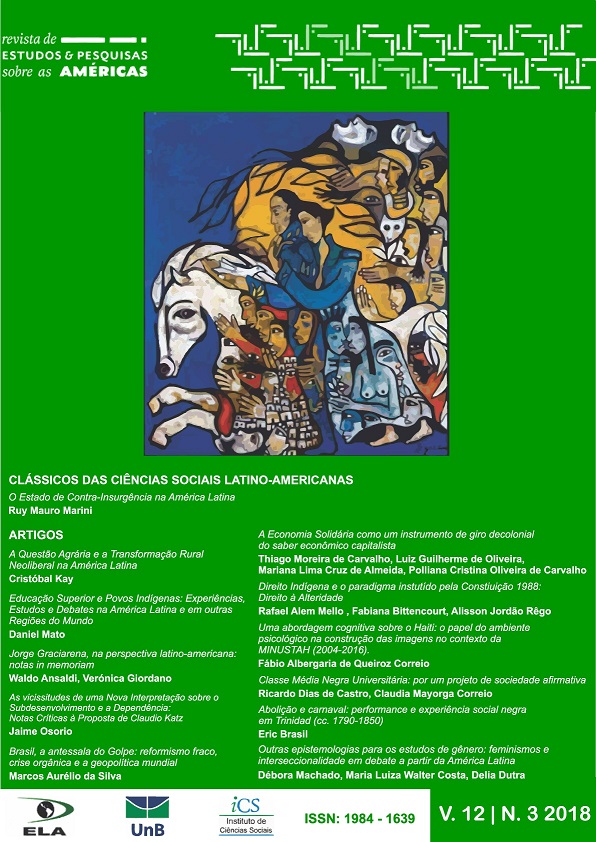
Brazil, the background of the coup d’état: weak reformism, organic crisis and global geopolitics
DOI:
https://doi.org/10.21057/repamv12n3.2018.31380Keywords:
Organic crisis, spatiality, geopolitics, coup in Brazil.Abstract
Using Antonio Gramsci's categories of analysis in his intrinsic spatiality, as well as exploring the strong geographical connections linked to the uneven development that touches the historical process of Brazilian social formation, and especially the links with world geopolitics and the international division of labor inherent to this development, the article discusses the conditions that forged the coup d'état against Dilma Rousseff in the year 2016. The proposed approach turns to the criticism of either the economic explanation or the one that despises the social relations that are rooted in capitalist production. This is an interpretation in terms of social totality, which is the meaning of the organic crisis in Gramsci, highlighting the relations between structure, space and superstructure. From the point of view of the historical process of Brazilian social formation, the article starts from a dialogue with classical and current interpretations that provide elements to the definition of the problem of unequal development in its internal and international relations. The conclusion indicates that the Brazilian coup of 2016 resulted from a complex interplay among the internal contradictions of the national social formation, themselves of clear spatial expression, and the most recent geopolitical interests of the United States.
References
AMORIM, Celso. Breves narrativas diplomáticas. São Paulo, Benvirá, 2013.
ARCARY, Valério. Junho de 2013 a 2015: as „placas tectônicas”Ÿ começaram a se mover? In: Crítica marxista, no. 42, 2016.
AZZARÀ, Stefano. G. Restaurazione e rivoluzione passiva postmoderna nel ciclo neoliberale: un trasformismo intellettuale di massa. In: Historical Materialism Rome Conference 2015. Roma, 17-19 settembre 2015.
BOITO Jr, Armando. Governos Lula: a nova burguesia nacional no poder. In: Boito, A. e Galvão, A. (orgs.). Política e classes sociais no Brasil dos anos 2000. São Paulo: Alameda; Fapesp, 2012.
_____. A crise política do neodesenvolvimentismo e a crise da democracia. In: Crítica marxista, no. 42, 2016a.
____. Os atores e o enredo da crise política. In: Por que gritamos golpe?: para entender o impeachment e a crise. In: Jinkings, I. Doria, K. Cleto, M. (orgs.). São Paulo: Boitempo, 2016b.
COITINHO, Rita. M. Entre duas Américas (Geografia Política da Inserção do Brasil na América Latina). Tese de Doutorado. Universidade Federal de Santa Catarina. Programa de Pós-Graduação em Geografia, Florianópolis, 2018.
COMPARATO, Fábio K. O impeachment as oligarquias. In: Carta Capital, no 1001, maio 2018. DOBB, Maurice. A evolução do capitalismo. 9 ed. Trad. M. R. Braga. Rio de Janero: LTC, 1987.
DRUMMOND, Carlos. A marinha mostra o rumo. In: Carta Capital, no. 974, out. 2017.
ESCOBAR, Pepe. Império do Caos. Vol 1. Trad. Renato Aguiar. Rio de Janeiro: Revan, 2016.
FERRARI, Levi. B. Da nova guerra fria ao impeachment de Dilma. In: Proner, C., Cittadino, G., Tenenbaum, M. e Filho, W. R. (orgs.). A resistência ao golpe de 2016. Bauru-SP: Canal 6, 2016.
GALVÃO, Luís A. A crítica acrítica da razão dualista. In: Debate e Crítica, no. 3, 1974.
GRAMSCI, Antonio. Quaderni del Carcere. Edizione critica dell”ŸIstituto Gramsci a cura di Valentino Gerratana.Torino: Einaudi, 1977.
GRIMALDI, Fulvio. Milosevic, l”Ÿultima intervista. In: GIUSTI, Roberto e HÖBEL, Alexander. La NATO in Jugoslavia: dalla guerra al colpo di Stato. Napoli: La Città del Sole, 2001.
LÊNIN, Vladimir I. Prefácio à segunda edição. In: O desenvolvimento do capitalismo na Rússia. O processo de formação do mercado interno para a grande indústria. Trad. J. P. Netto. 2 ed. São Paulo: Abril Cultural, 1982. _____. Imperialismo, fase superior do capitalismo. São Paulo: Global, 1987.
LEFEBVRE, Henri. De La ciudade a La sociedad urbana. In: La revolución urbana. 4 ed. Madrid: Alianza Editorial, 1983.
LIGOURI, Guido. Berlinguer rivoluzionario. Il pensiero político di un comunista democratico. Roma: Carocci, 2014.
LOJKINE, Jean. O estado capitalista e a questão urbana. Trad. E. dos S. Abreu. São Paulo: Martisn Fontes, 1981. LOSURDO, Domenico. Esiste oggi un imperialismo europeo? L’Ernesto Rivista, set. 2004.
_____. La non-violenza. Una storia fuori dal mito. Roma-Bari: Laterza, 2010.
_____. La lotta di classe. Una stora politica e filosofica. Roma-Bari: Laterza, 2013.
_____. Il marxismo occidentale. Come nacque, come morì, come può rinascere. Bari-Roma: Laterza, 2017. MAMIGONIAN, Armen. O enigma brasileiro atual: Lula será devorado? Ciência Geográfica, Bauru, no. 10, vol. 10 (2), maio/agosto, 2004.
MARX. Karl. Contribuição à crítica da economia política. 2 ed. Trad. M. H. B. Alves. São Paulo: Martins, 1983. MORTON, Adam. Gramsci em movimento: a espacialidade da revolução passiva. Trad. D. Mussi e C. Góes. In: Gramsci: periferia e subalternidade. Del Roio, M. (org.). São Paulo: Edusp, 2017.
NASSIF, Luis. Lava Jato: tudo começou em junho de 2013 com a Primavera brasileira. In: Proner, C., Cittadino, G., Tenenbaum, M. e Filho, W. R. (orgs.). A resistência ao golpe de 2016. Bauru-SP: Canal 6, 2016.
OLIVEIRA, Francisco. A economia brasileira: crítica à razão dualista. 6 ed. Petrópolis: Vozes, 1988.
POMAR, Valter. Brasil: variáveis estratégicas. In: Crítica marxista, no. 42, 2016. RANGEL, Ignácio. A história da dualidade brasileira. In: Revista de Economia Política, vol. 1, no. 4, out.-dez. 1981.
_____. Economia: milagre e anti-milagre. 2 ed. Rio de Janeiro: Jorge Zahar, 1986.
REHMANN, Jan. I nietzscheani di sinistra: Deleuze, Foulcault e il postmodernismo: una decostruzione. Trad. Azzarà , S. G. Roma: ODRADEK, 2009.
ROUSSEFF, Dilma. A segunda Torre de Dilma. Valor Econômico, 17.03.2017. Entrevista a Maria Cristina Fernandes. SAAD FILHO, Alfredo. Avanços, contradições e limites dos governos petistas. In: Crítica marxista, no. 42, 2016. SAFATLE, Vladimir. Parar de crescer. In: Carta Capital, no 784, jan. 2014. https://www.cartacapital.com.br/revista/784/parar-de-crescer-5994.html (Acesso 25.05.18) SANTOS, Milton. Por uma geografia nova. São Paulo: Edusp, 2008.
SANTOS, Wanderley G. dos. A democracia impedida: o Brasil no século XXI. Rio de Janeiro: FGV, 2017. SILVA, Marcos A. da. La crisi politica brasiliana. Gramsci Oggi, no. 2, jul. 2013a.
_____. Na senda do reformismo: o Brasil sob os governos do PT. Crítica e sociedade: revista de cultura política, vol. 3, no. 2, dez. 2013b.
_____. Imperialismo e geopolítica: a luta de classes nas eleições brasileiras. Princípios, no. 131, jun.-jul. 2014. SINGER, André. Os sentidos do lulismo. Reforma gradual e pacto conservador. São Paulo: Companhia das Letras, 2012.
_____. A (falta de) base política para o ensaio desenvolvimentista. In: As contradições do lulismo: a que ponto chegamos? São Paulo: Boitempo, 2016. STONE, Oliver. As entrevistas de Putin. Trad. C. Szlak, Rio de Janeiro: BestSeller, 2017.
SOUZA, Jessé. A radiografia do golpe. Rio de Janeiro: LeYa, 2016.
Downloads
Published
Issue
Section
License
The published material is the property of the Journal, and may be reproduced in whole or in part with indication of the source.
Copyright: Authors will be responsible for obtaining the copyright of the material used. Authors who publish in this journal agree to the following terms:
a)Authors retain the copyright and grant the journal the right of first publication, with the work simultaneously licensed under
the Creative Commons Attribution License which allows the sharing of work with acknowledgment of authorship and initial publication in this journal.
b) Authors are authorized to take additional contracts separately, for non-exclusive distribution of the version of the work published in this journal (eg, publish in institutional repository or as a book chapter), with acknowledgment of authorship and initial publication in this journal.
c) Authors are allowed and encouraged to publish and distribute their work online (eg in institutional repositories or on their personal page) at any point before or during the editorial process, as this can generate productive changes as well as increase the impact and the citation of the published work (See The Effect of Free Access).