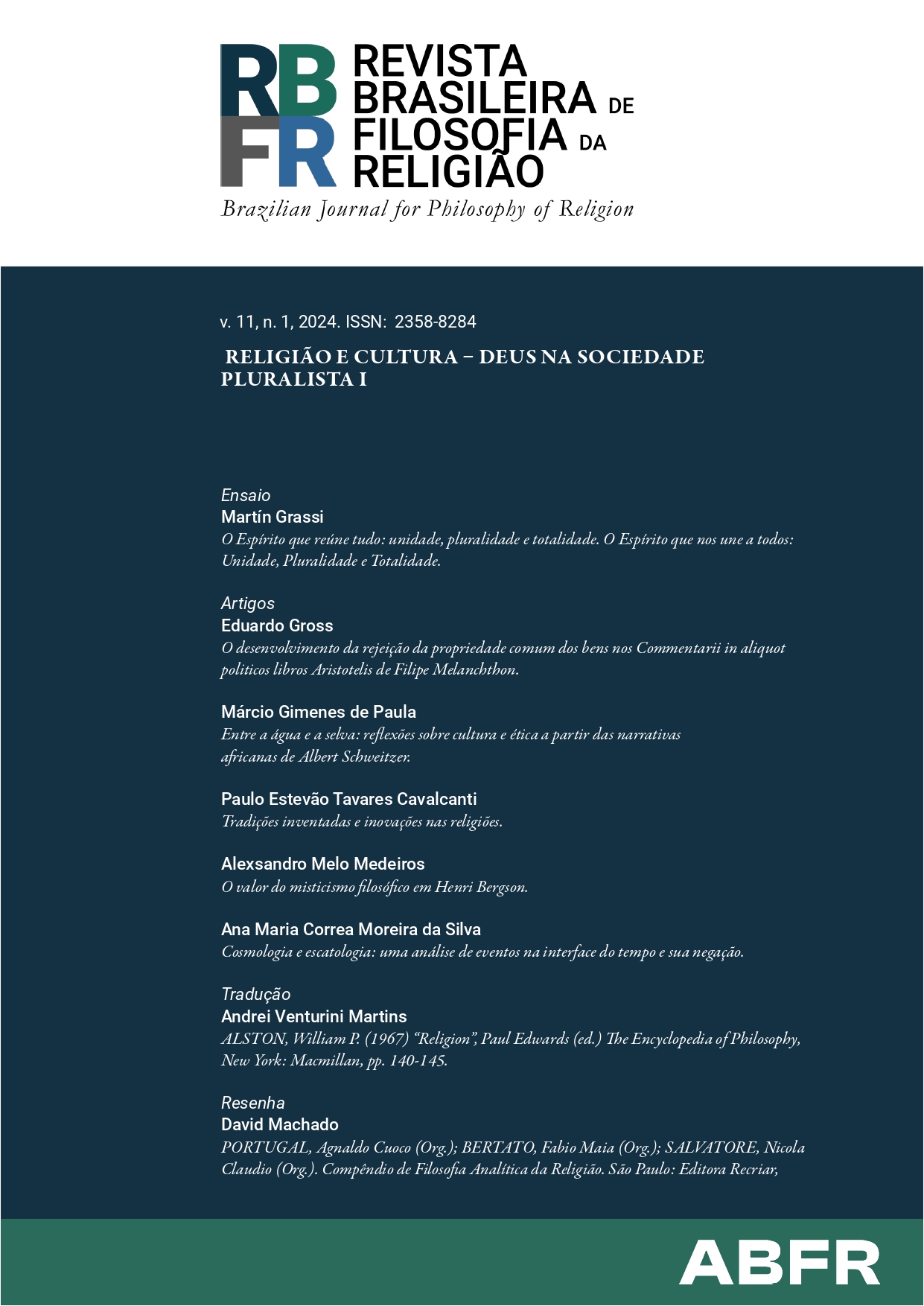
Cosmologia e escatologia: uma análise de eventos na interface do tempo e sua negação
DOI:
https://doi.org/10.26512/2358-82842024e58971Keywords:
Cosmologia, Escatologia Cristã, Morte, Tempo, EternidadeAbstract
The aim of this work is to philosophically analyze events that challenge the very concept of temporality, because their occurrence entails the creation or elimination of time itself. Examples are found in the realms of cosmology and Christian eschatology—for instance, the origin of the universe and the death of an individual—events that occur at the boundaries of the first and last instants of a temporal series, respectively. These are events that take place with time, not in time, owing to their radical nature as an irruption or rupture. In cosmology, we have the universe’s emergence according to the standard Big Bang theory, as well as the Kalam Cosmological Argument, which posits a first cause for the universe’s existence based on the impossibility of an infinite temporal regress. This argument presupposes an absolute beginning of the universe, and of time itself, through creation ex nihilo by an atemporal God. In Christian eschatology, we have the Theory of Resurrection at Death, which holds that individual resurrection occurs immediately upon death, since death marks the transition into atemporal eternity. The theory implies the simultaneity of all eschatological events—death, resurrection, and the Final Judgment—from the standpoint of eternity, grounded in the incommensurability between the dimensions of time and eternity. The shared nature of these two singular events in cosmology and eschatology reveals intriguing aspects of the interface between time and its negation, which will be examined.
References
BRÜNNER, Emil (1965). Das Ewige als Zukunft und Gegenwart. München: Siebenstern Taschenbuch Verlag.
COPAN, Paul & William L. Craig (Eds.) (2019). The Kalam Argument. Philosophical Arguments for the Finitude of the Past. New York: Bloomsbury Publishing Inc.
CRAIG, William L. & James D. Sinclair (2009). “The Kalam cosmological argument” in The Blackwell Companion to Natural Theology, by W. L. Craig and J. P. Moreland (Eds.). Oxford: Blackwell Publishing: 101-201.
FEINER, Johannes & Loehrer, Magnus (Orgs.) (1985). Mysterium Salutis – Do Tempo para a Eternidade, 3. A Escatologia. Petrópolis: Ed. Vozes.
FOX, Rory. Time and Eternity in Mid-Thirteenth Century Thought. (2006). New York: Oxford University Press.
GRESHAKE, Gisberg & Gerhard Lohfink (1975). Naherwartung, Auferstehung, Unsterblichkeit. Untersuchungen zur christilichen Eschatologie. Quaestiones Disputatae (QD) 71. Freiburg: Herder.
JAMMER, Max (2006). Concepts of simultaneity. From Antiquity to Einstein and beyond. Baltimore: The John Hopkins University Press.
KANT, Immanuel (2015). Crítica da Razão Pura. Tradução de Fernando Costa Mattos. 4.ed. Petrópolis: Ed. Vozes.
LE POIDEVIN, Robin. (2003). Travels in Four Dimensions. The Enigmas of Space and Time. Oxford: Oxford University Press.
NEWTON-SMITH, William H. (1984). The Structure of Time. London: Routledge & Kegan Paul.
RATZINGER, Joseph (1988). Eschatology: Death and Eternal Life. Washington: The Catholic University of American Press.
RUIZ DE LA PEÑA, Juan Luis (1979). La Otra Dimensión. Escatología Cristiana. Madrid: Sal Terrae.
SUSIN, Luiz Carlos (2018). O Tempo e a Eternidade: A Escatologia da Criação. Petrópolis: Ed. Vozes.
YATES, Stephen (2017). Between Death and Resurrection. A Critical Response to Recent Catholic Debate Concerning the Intermediate State. New York: Bloomsbury Publishing Inc.
Downloads
Published
Issue
Section
License
Copyright (c) 2025 Ana Maria Correa Moreira da Silva

This work is licensed under a Creative Commons Attribution 4.0 International License.