In front of the theatre, at the museum, from the archive.
Scenic (and authorial) modes of contemporary art
DOI:
https://doi.org/10.1590/10.1590/2316-4018557Abstract
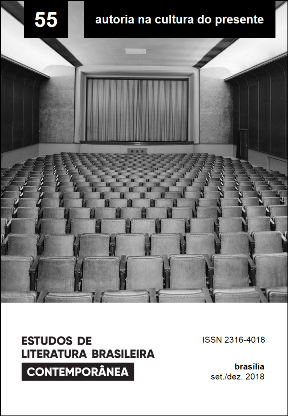
In the Mínimo teatral exhibition (Macro Museum, Rosario, 2017) we worked, as curators, on how theatre resonates in contemporary art, exploring the different appropriations of theatricality and staging in various art forms. Our intention was to promote a dialogue between visual and scenic arts, even when the exchanges did not occur through direct reference and/or comments between different artistic expressions. At the same time, we were not trying to formulate a history of art (history of the disciplinary field, of their conversations or misunderstandings), though we did inquire into the uses of the archive and its effects in a possible conceptualization of time. This essay proposes to present a perspective and a reflection about that experience. The questions broached are: Which zones (sensitive, social, productive) are enabled by theatrical thought? Which are the effects of the assembly and archive of theatre in the museum? Which would be the effects on the conceptualization and the uses of time? And finally, what repercussions did the research and the hypothesis proposed by the exhibit have for the curatorship not only in what it pertains to the dialogue between theater and art, but also in regards to the archive.
References
AGAMBEN, Giorgio (2009). El autor como gesto. In: AGAMBEN, Giorgio Profanaciones. Buenos Aires: Adriana Hidalgo.
BOURRIAUD, Nicolas (2007). Postproducción. La cultura como escenario: modos en que la cultura reprograma el mundo contemporáneo. Buenos Aires: Adriana Hidalgo.
DERRIDA, Jacques (1997). Mal de archivo: una impresión freudiana. Madrid: Trotta.
FARGE, Arlette (1991). La atracción del archivo. Valencia: Alfons El Magnanim.
FOUCAULT, Michel (1967/1984). Des espaces autres. Architecture, Mouvement, Continuité, Paris, n. 5, p. 46-49, out.
FOUCAULT, Michel (1969/1996). La arqueología del saber. México: Siglo XXI.
GARBATZKY, Irina (2017). Mínimo teatral. La invención del acto. Guía de Visita, Rosario, Castagnino+Macro, n. 31.
GROYS, Boris (2011). El curador como iconoclasta. Denken Pensée Thought Mysl…, La Habana, n. 2, p. 23-34, 15 feb.
GROYS, Boris (2014). Volverse público: las transformaciones del arte en el ágora contemporánea. Buenos Aires: Caja Negra.
KLINGER, Diana (2013). Sobre a (im)possibildade de alcançar o outro. Grumo, Buenos Aires/Rio de Janeiro, n. 10, p. 84-89. Disponible en: <https://goo.gl/Lq4fgR>. Acceso: 23 mar. 2018.
MACBA ”“ MUSEU D’ART CONTEMPORANI DE BARCELONA (Org.). (2007). Un teatro sin teatro. Barcelona: Museu d’Art Contemporani de Barcelona; Lisboa: Fundaçao de Arte Moderna e Contemporanea/Colecçao Berardo. Catálogo de exposición
PINTA, María Fernanda (2017). Mínimo teatral. Cantidad necesaria. Guía de Visita, Rosario, Castagnino+Macro, n. 31.
Downloads
Published
Issue
Section
License
Authors who publish in this journal agree to the following terms:
a) The authors maintain the copyright and grant the journal the right of first publication, the work being simultaneously licensed under the Creative Commons Attribution License-Non Commercial 4.0 which allows the sharing of the work with acknowledgment of the authorship of the work and publication this journal.
b) Authors are authorized to enter into additional contracts separately, for non-exclusive distribution of the version of the work published in this journal (eg publish in institutional repository or as a book chapter), with authorship recognition and publication in this journal.
c) Authors are allowed and encouraged to publish and distribute their work online (eg in institutional repositories or on their personal page) after the editorial process, as this can generate productive changes, as well as increase the impact and citation of published work (See The Effect of Free Access).
d) The authors of the approved works authorize the magazine to, after publication, transfer its content for reproduction in content crawlers, virtual libraries and the like.
e) The authors assume that the texts submitted to the publication are of their original creation, being fully responsible for their content in the event of possible opposition by third parties.