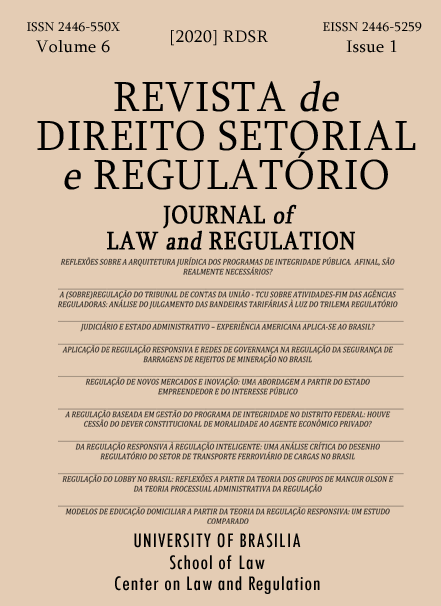
The (Over)Regulation of the Federal Court of Accounts - FCA on Regulatory Agencies' core activities
analysis of the judgment of the Tariff Flags in light of Regulatory Trilemma
DOI:
https://doi.org/10.26512/2446-52592020e28464Palabras clave:
controle, TCU, agências reguladoras, trilema regulatório, bandeiras tarifáriasResumen
Abstract
Purpose – The study aims to analyze whether the application of FCA’s practice in the control of regulatory agencies' core activities represents a regulatory failure – overregulation, under the criteria of the Regulatory Trilemma.
Methodology/approach/design – A dogmatic and socio-juridical approach is adopted, based on the theory of law as an autopoietic system, proceeding to the doctrinal, normative and jurisprudential overview. The article conducts a critical examination of reflexivity regarding the FCA commands directed to Regulatory Agencies’ core activities. The empirical examination is adopted by electing a recent case, the FCA's judgment of the Tariff Flags.
Findings – The article concludes that FCA's commands to Regulatory Agencies in controlling end-activities imply a regulatory failure in the form of over-regulation, under the perspective of Regulatory Trilemma.
Practical implications – The research result offers a theoretical basis for the revision of FCA’s practice regarding the control of the regulatory agencies' core activities.
Originality/value – The article establishes an argumentative basis for reorienting the practice of FCA's operational control over regulatory agencies, so that the results of the control of the auditing body are reported to the National Congress, extinguishing direct commands to the agencies, either in the form of recommendations, or determinations.
Descargas
Citas
Descargas
Publicado
Cómo citar
Número
Sección
Licencia
Derechos de autor 2020 Revista de Direito Setorial e Regulatório

Esta obra está bajo una licencia internacional Creative Commons Atribución 4.0.
Al enviar este documento a la Revista de Derecho, Estado y Telecomunicaciones, declaro que estoy aceptando los términos de Creative Commons Attribution 4.0 International (CC BY 4.0), disponible en http://creativecommons.org/licenses/by/4.0.